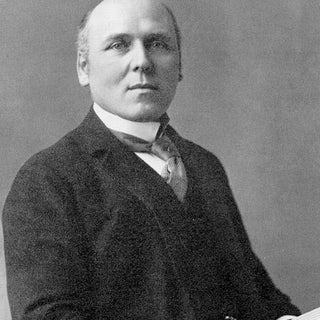
Willard Leroy Metcalf was born in Lowell, Massachusetts, in 1858, into a working-class family. He began painting in 1874, apprenticed to a wood engraver and then studied with the landscape painter George Loring Brown. In 1876 he opened a studio in Boston and won a scholarship to the school of the Museum of Fine Arts, Boston, where he studied until 1878.
His early career was as a figure painter and illustrator. He travelled to the American Southwest, where he drew the Zuni people for illustrated articles in Century Magazine. An exhibition of his work in Boston in 1882 raised enough money to take him to Europe.
Metcalf left for Paris in 1883 and stayed for five years. He studied at the Académie Julian, painted in England and Brittany, and in 1885 was one of the first Americans to visit Giverny, the village where Claude Monet lived. American painters soon flocked there. Sunlight and Shadow (1888) in our collection was painted in France at the end of this period.
Back in the United States, he worked as an illustrator and portraitist and taught at the Art Students League and Cooper Union in New York. In 1897 he was a founder of the Ten American Painters, the group of American Impressionists who broke away from the Society of American Artists, alongside Childe Hassam, John Henry Twachtman and others.
Metcalf's real breakthrough came in 1903–04, when he spent time painting at his parents' home in Clark's Cove, Maine, and found his true subject: the New England landscape. He painted its hills, rivers, birch woods, farmhouses and villages in every season, with clear, fresh colour and a calm, carefully composed design. He worked at the art colony in Old Lyme, Connecticut, and later at Cornish, New Hampshire.
He became especially known for winter and early spring, showing snow, ice, thaw and the first green of the trees. The Budding Oak (1916) captures the moment of spring leafing. Icebound Brook (1922) and Indian Summer, Vermont (1922), from his late years in Vermont, show the frozen and autumn sides of the same countryside. His landscapes were commercially successful, and he won many awards.
Metcalf died in New York in 1925. His paintings are held by the Metropolitan Museum of Art, the Smithsonian American Art Museum, the Florence Griswold Museum in Old Lyme and the Museum of Fine Arts, Boston.

 Snow & Moving Water · from $59
 Homer’s Atlantic · from $109
 Van Gogh in Colour · from $119
 Monet’s Changing Light · from $79
 Coastal Calm · from $109
 Harbour Days · from $59
 The Kitchen Table · from $79
 City Walks · from $119
 The Portrait Salon · from $109
 Early Modern Colour · from $79
 Blue Hour · from $119
 Golden Fields · from $109
 Field & Farm · from $59
 Vincent van Gogh
 Claude Monet
 Gustav Klimt
 Winslow Homer
 John Singer Sargent
 Mary Cassatt
 Alphonse Mucha
 William Merritt Chase
 Childe Hassam
 Frederic Remington