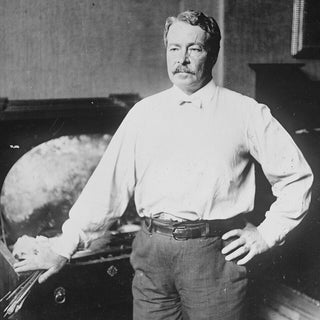
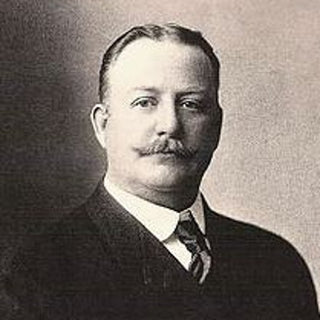
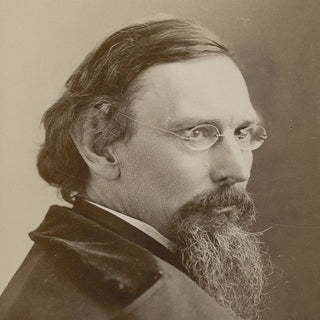
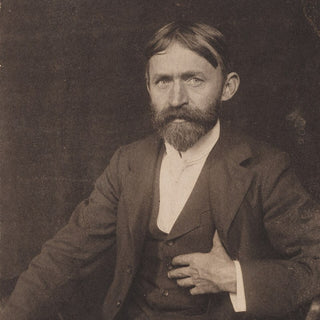
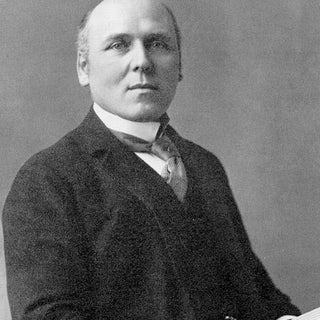
Howard Pyle was born in Wilmington, Delaware, in 1853, into a Quaker family. His mother loved books and pictures and encouraged his drawing. He studied art in Philadelphia with a Belgian teacher, Francis Van der Wielen, and briefly at the Art Students League in New York, but he was mostly self-taught.
He began by writing and illustrating stories and poems for magazines. In 1876 his work was published in Scribner's Monthly, and he moved to New York to work for Harper & Brothers and other publishers. Over the next few years he learned his trade fast. In 1880 he returned to Wilmington, where he lived and worked for most of his life.
Yankee Doodle: An Old Friend in a New Dress (1881) was one of his first books, an illustrated version of the old song printed in colour. Our collection includes three of its plates, full of comic eighteenth-century characters.
Pyle became famous as both author and illustrator. His books for young readers include The Merry Adventures of Robin Hood (1883), Otto of the Silver Hand (1888), and his four volumes on King Arthur, starting with The Story of King Arthur and His Knights (1903). He also wrote and painted pirate stories, and his image of pirates, with sashes, earrings and swagger, is the one that later films and costumes have borrowed.
American history was his other great subject. He illustrated the colonial era and the Revolution for Harper's Monthly and other magazines with careful research into costume and setting. Paul Revere Bringing News to Sullivan (1886) is one of these historical pictures.
Pyle was also a hugely influential teacher. He taught illustration at the Drexel Institute in Philadelphia from 1894. In 1900 he opened his own school in Wilmington, with summer classes at Chadds Ford on the Brandywine River, and he charged no tuition. He taught his students to imagine themselves inside a scene and to live in the picture. They included N. C. Wyeth, Maxfield Parrish, Jessie Willcox Smith, Frank Schoonover and Elizabeth Shippen Green. His followers became known as the Brandywine School.
In 1910 Pyle travelled to Italy to study mural painting. He died in Florence in 1911. The Delaware Art Museum in Wilmington holds the largest collection of his work, and his influence can still be seen in illustrated books, magazines and films today.
 Vincent van Gogh
 Claude Monet
 Gustav Klimt
 Winslow Homer
 John Singer Sargent
 Mary Cassatt
 Alphonse Mucha
 William Merritt Chase
 Childe Hassam
 Frederic Remington

 Snow & Moving Water · from $59
 Homer’s Atlantic · from $109
 Van Gogh in Colour · from $119
 Monet’s Changing Light · from $79
 Coastal Calm · from $109
 Harbour Days · from $59
 The Kitchen Table · from $79
 City Walks · from $119
 The Portrait Salon · from $109
 Early Modern Colour · from $79
 Blue Hour · from $119
 Golden Fields · from $109
 Field & Farm · from $59All gallery walls ›