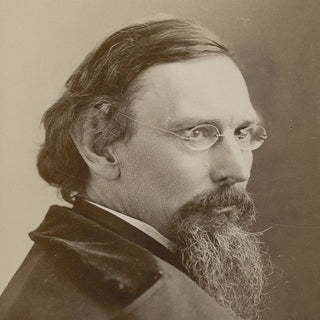
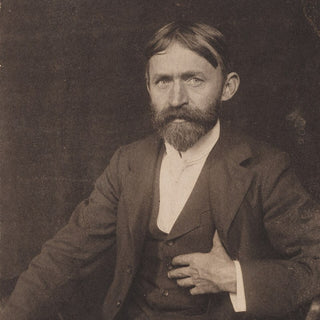
George Inness was born in 1825 near Newburgh, New York, and grew up in New York City and Newark, New Jersey. He suffered from epilepsy all his life. As a young man he trained briefly as a map engraver, and took lessons from the French landscape painter Régis François Gignoux. He was largely self-taught, learning by studying the old masters through prints.
His early landscapes were close to the Hudson River School, the dominant American landscape style of the day, detailed, panoramic and often grand. The Lackawanna Valley (1856), now at the National Gallery of Art, painted for a railroad company, is his best-known work from this time.
Trips to Europe changed his approach. In Italy and especially in France in the 1850s he saw the work of the Barbizon painters, among them Théodore Rousseau and Camille Corot, who painted the countryside with loose brushwork, rich colour and an intimate, personal mood. Inness turned away from detailed views toward atmosphere, feeling and unity of tone.
He was also a deeply religious man, a follower of the eighteenth-century mystic Emanuel Swedenborg, who taught that the physical world corresponds to the spiritual one. Inness believed that a landscape painting should not just describe a place but convey an emotion and a spiritual reality. He said that the purpose of art was to awaken an emotion.
The works in our collection follow his mature development. The Triumph at Calvary (1874) is a rare religious subject. The Storm (1876) shows his dramatic sense of weather. In his last years his paintings became softer and more mysterious, with forms dissolving into mist, twilight and glowing light. Harvest Moon (1891) and Early Morning, Tarpon Springs (1892), painted at his winter home in Florida, are from this final period, which is now considered his finest.
Inness lived for many years in Montclair, New Jersey, and painted the local landscape. Late in life he achieved real success, and his work sold for high prices. He died in 1894 at the Bridge of Allan in Scotland, while travelling.
He is often called the father of American Tonalism. His work is held by the Metropolitan Museum of Art, the National Gallery of Art, the Montclair Art Museum and the Art Institute of Chicago.

 Snow & Moving Water · from $59
 Homer’s Atlantic · from $109
 Van Gogh in Colour · from $119
 Monet’s Changing Light · from $79
 Coastal Calm · from $109
 Harbour Days · from $59
 The Kitchen Table · from $79
 City Walks · from $119
 The Portrait Salon · from $109
 Early Modern Colour · from $79
 Blue Hour · from $119
 Golden Fields · from $109
 Field & Farm · from $59
 Vincent van Gogh
 Claude Monet
 Gustav Klimt
 Winslow Homer
 John Singer Sargent
 Mary Cassatt
 Alphonse Mucha
 William Merritt Chase
 Childe Hassam
 Frederic Remington