Marie-Rosalie Bonheur was born in Bordeaux in 1822, the eldest child of the painter and drawing teacher Raymond Bonheur. The family moved to Paris when she was a child. Her father, a follower of the utopian Saint-Simonian movement, believed in the equality of women, and he trained her himself. Her siblings became artists too. She learned by copying in the Louvre and by studying animals directly, sketching them in fields, at horse fairs and even in slaughterhouses, and dissecting animal parts to understand anatomy.
She exhibited at the Paris Salon from the age of nineteen, and won a gold medal in 1848. The French state then commissioned a painting from her. The result was Ploughing in the Nivernais (1849), a team of oxen breaking the soil under a wide autumn sky, now at the Musée d'Orsay. Our Ploughing in Nevers (1849) is from the same moment and subject, and it made her reputation.
Her most famous work is The Horse Fair (1852–55), now at the Metropolitan Museum of Art: a huge canvas of horses being paraded at the horse market in Paris. To study it, she visited the market twice a week for a year and a half. To work there without attracting attention, she obtained police permission to wear trousers, which was otherwise illegal for women in Paris. The painting toured Britain and America and made her famous in the English-speaking world. Queen Victoria asked to see it.
Bonheur painted animals of every kind, from farm cattle and sheep to hunting dogs, horses, deer and big cats, which she kept in her studio menagerie. Our A Limier Briquet Hound (around 1856) and the study Tête de lion relevée (lion's head raised) show the range of her animal portraits.
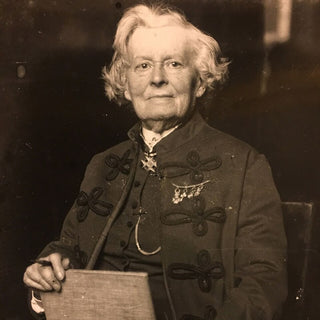
With the money from her success, she bought the Château de By, at Thomery near the forest of Fontainebleau, in 1859, and lived there for the rest of her life with her partner Nathalie Micas and later the American painter Anna Klumpke. She kept horses, dogs, sheep and lions on the estate.
In 1865 she became the first woman artist to receive the Legion of Honour, presented to her by Empress Eugénie. In 1889, when Buffalo Bill's Wild West show came to Paris, she visited the encampment and painted Colonel William F. Cody on his white horse. Our Col. William F. Cody (Buffalo Bill) (1889) is that portrait, now in the Buffalo Bill Center of the West in Cody, Wyoming.
Bonheur died at By in 1899. Her château is now a museum, the Château de Rosa Bonheur, with her studio preserved as she left it.
 Vincent van Gogh
 Claude Monet
 Gustav Klimt
 Winslow Homer
 John Singer Sargent
 Mary Cassatt
 Alphonse Mucha
 William Merritt Chase
 Childe Hassam
 Frederic Remington

 Snow & Moving Water · from $59
 Homer’s Atlantic · from $109
 Van Gogh in Colour · from $119
 Monet’s Changing Light · from $79
 Coastal Calm · from $109
 Harbour Days · from $59
 The Kitchen Table · from $79
 City Walks · from $119
 The Portrait Salon · from $109
 Early Modern Colour · from $79
 Blue Hour · from $119
 Golden Fields · from $109
 Field & Farm · from $59All gallery walls ›