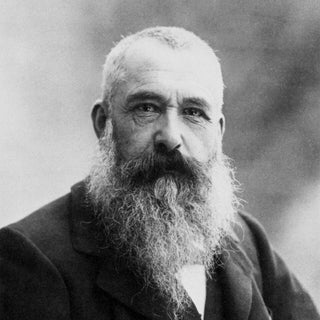
Claude Monet was born in Paris in 1840 and grew up in Le Havre, on the Normandy coast. As a teenager he was locally famous for caricatures, which he sold for a few francs each. The landscape painter Eugène Boudin noticed him and persuaded him to paint outdoors. Monet later said that his eyes were finally opened by Boudin, and that he understood nature because of him.
In Paris in the early 1860s he met Pierre-Auguste Renoir, Alfred Sisley and Frédéric Bazille. The group wanted to paint modern life and the open air rather than history and myth, and they worked side by side along the Seine and in the forest of Fontainebleau. Money was a constant problem, and Monet's letters from these years are full of requests for loans.
In 1874 the group organized their own exhibition, independent of the official Salon. Monet showed a painting of Le Havre harbour in morning mist called Impression, Sunrise. A critic mocked the title, and the name "Impressionists" stuck. Monet was living in Argenteuil, just outside Paris, at the time. Several of the works in our collection come from those years, including The Promenade with the Railroad Bridge, Argenteuil (1874) and Regattas at Argenteuil (around 1872), with their sailing boats, bridges and quick, broken brushwork.
Monet travelled to paint, always chasing particular light. In 1884 he spent months on the Mediterranean at Bordighera and along the Riviera, and struggled with what he called the "fairy-tale" colours of the south. Villas at Bordighera and La Corniche near Monaco come from that trip. In 1896 and 1897 he returned to the Normandy cliffs at Pourville, the setting of Falaise de Pourville.
In 1883 he moved to Giverny, a village on the Seine west of Paris, and stayed for the rest of his life. He planted a flower garden and later a water garden with a Japanese-style bridge, and the garden became his main subject. The Artist's Garden in Giverny (1900) shows the flower beds before the water lilies took over his work.
From the 1890s he painted in series, returning to the same haystacks, poplars and the facade of Rouen Cathedral at different hours and seasons. In his last decades, despite cataracts, he worked on the huge Water Lilies panels that he gave to the French state, now installed at the Musée de l'Orangerie in Paris. He died at Giverny in 1926. His house and gardens are open to visitors, and his paintings are among the most loved in the world.
 Vincent van Gogh
 Claude Monet
 Gustav Klimt
 Winslow Homer
 John Singer Sargent
 Mary Cassatt
 Alphonse Mucha
 William Merritt Chase
 Childe Hassam
 Frederic Remington

 Snow & Moving Water · from $59
 Homer’s Atlantic · from $109
 Van Gogh in Colour · from $119
 Monet’s Changing Light · from $79
 Coastal Calm · from $109
 Harbour Days · from $59
 The Kitchen Table · from $79
 City Walks · from $119
 The Portrait Salon · from $109
 Early Modern Colour · from $79
 Blue Hour · from $119
 Golden Fields · from $109
 Field & Farm · from $59All gallery walls ›