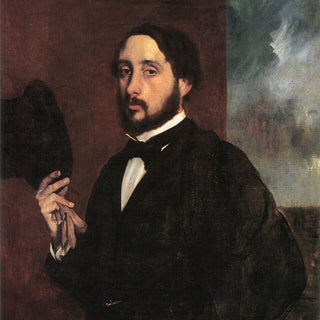
Hilaire-Germain-Edgar Degas was born in Paris in 1834 into a prosperous banking family. He studied law briefly, then entered the École des Beaux-Arts in 1855, where he trained in the classical tradition of Ingres, whom he admired all his life. He spent three years in Italy copying the old masters and studying drawing. His early ambition was to become a history painter.
In the 1860s he met Édouard Manet, who drew him towards subjects from modern life. Degas took part in the Impressionist exhibitions from the first one in 1874, and helped organise them. He exhibited in seven of the eight. But he disliked the name "Impressionist", preferring to call himself a realist, and unlike Monet he had little interest in painting outdoors. He worked in the studio, from drawings, memory and close observation.
His great subjects were the Paris of his day: theatres, cafés, laundresses, milliners and, above all, ballet dancers and racehorses. He was fascinated by movement and by people at work, seen at unguarded moments. Influenced by photography and Japanese prints, he used unusual viewpoints, cut-off figures, empty foregrounds and off-centre compositions that still feel modern.
Ballet was his most famous subject. He painted, drew and sculpted dancers more than any other subject, focusing less on the performance than on rehearsals, classes and waiting in the wings. The Dance Class (1873) and Ballet Dancers (around 1877) in our collection belong to this famous body of work.
The races at Longchamp gave him a different kind of motion: horses and jockeys gathering before the start. Race Horses (around 1885–88) in our collection is one of these scenes. Degas studied Eadweard Muybridge's photographs of horses in motion to get their movement right.
Beach at Low Tide (Mouth of the River) (1869) shows a less familiar side: during a summer on the Normandy coast, he made a series of small, spare landscape studies of the shore.
From the 1880s, as his eyesight worsened, Degas worked increasingly in pastel, which he used with extraordinary boldness. He also made sculpture, most famously the Little Dancer Aged Fourteen. He withdrew more and more from public life in his later years.
Degas died in Paris in 1917. His work is held by the Musée d'Orsay in Paris, the Metropolitan Museum of Art, the National Gallery of Art and many other museums.
 Vincent van Gogh
 Claude Monet
 Gustav Klimt
 Winslow Homer
 John Singer Sargent
 Mary Cassatt
 Alphonse Mucha
 William Merritt Chase
 Childe Hassam
 Frederic Remington

 Snow & Moving Water · from $59
 Homer’s Atlantic · from $109
 Van Gogh in Colour · from $119
 Monet’s Changing Light · from $79
 Coastal Calm · from $109
 Harbour Days · from $59
 The Kitchen Table · from $79
 City Walks · from $119
 The Portrait Salon · from $109
 Early Modern Colour · from $79
 Blue Hour · from $119
 Golden Fields · from $109
 Field & Farm · from $59All gallery walls ›