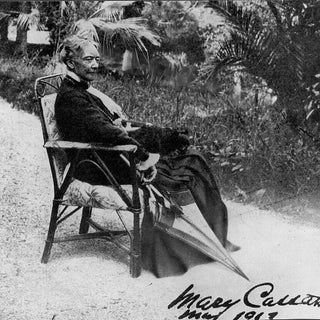
Mary Stevenson Cassatt was born in 1844 in Allegheny City, now part of Pittsburgh, Pennsylvania, into a well-off family. As a child she spent several years in Europe with her parents. At fifteen she enrolled at the Pennsylvania Academy of the Fine Arts in Philadelphia, but found the teaching slow and limited. In 1866 she moved to Paris. Women could not yet attend the École des Beaux-Arts, so she studied privately and copied paintings in the Louvre.
In the 1870s she had paintings accepted by the Paris Salon. She also grew tired of its conventions, and saw something new in the pastels of Edgar Degas in a gallery window. She later said that seeing them changed her life. In 1877 Degas invited her to exhibit with the Impressionists, and she became the only American to show with the group in Paris, taking part in four of their exhibitions from 1879.
Two works in our collection are from the moment she joined them, both dated 1878. Little Girl in a Blue Armchair shows a bored child sprawled on an overstuffed chair in a room full of blue furniture. Degas advised her on the background. In the Loge shows a young woman at the opera, part of a group of theatre pictures Cassatt painted that explored women watching and being watched.
From the 1880s Cassatt focused on the subject she is best known for: women in everyday domestic settings, and particularly mothers and children. She painted them without sentimentality, intimate and closely observed. Child in a Straw Hat (1886), Maternal Caress (1891) and Gathering Fruit (1893) all come from this period. Gathering Fruit relates to her work on a mural, Modern Woman, which she painted for the Woman's Building at the World's Columbian Exposition in Chicago in 1893.
After seeing an exhibition of Japanese woodblock prints in Paris in 1890, she produced a celebrated set of ten colour prints, combining drypoint and aquatint, that are among the most admired prints of the period.
Cassatt also played an important part in American collecting. She advised wealthy friends, including Louisine and Henry Havemeyer, on buying Impressionist and old master paintings, many of which are now in the Metropolitan Museum of Art.
Failing eyesight forced her to stop working around 1914. She supported women's suffrage, and died at her country house, the Château de Beaufresne, near Paris, in 1926. Her work is held by the National Gallery of Art in Washington, the Met and the Art Institute of Chicago, among others.
 Vincent van Gogh
 Claude Monet
 Gustav Klimt
 Winslow Homer
 John Singer Sargent
 Mary Cassatt
 Alphonse Mucha
 William Merritt Chase
 Childe Hassam
 Frederic Remington

 Snow & Moving Water · from $59
 Homer’s Atlantic · from $109
 Van Gogh in Colour · from $119
 Monet’s Changing Light · from $79
 Coastal Calm · from $109
 Harbour Days · from $59
 The Kitchen Table · from $79
 City Walks · from $119
 The Portrait Salon · from $109
 Early Modern Colour · from $79
 Blue Hour · from $119
 Golden Fields · from $109
 Field & Farm · from $59All gallery walls ›