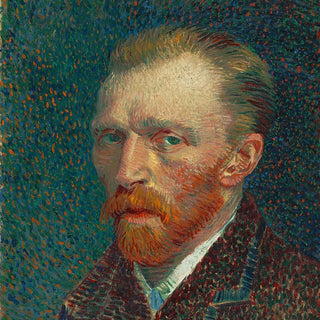
Vincent van Gogh was born in 1853 in Groot-Zundert, in the south of the Netherlands, the son of a Protestant minister. At sixteen he joined the international art dealers Goupil & Cie, working in The Hague, London and Paris. He was later dismissed. He then tried teaching, then the ministry, and in 1879 worked as a lay preacher among coal miners in the Borinage region of Belgium. In 1880, aged twenty-seven, he decided to become an artist.
He taught himself largely by drawing, copying prints and working through instruction manuals. His younger brother Theo, an art dealer in Paris, supported him financially for the rest of his life, and the hundreds of letters between the two are one of the most important records we have of any artist's thinking.
His early work is Dutch, dark and earthy. He painted and drew peasants and weavers in Drenthe and in Nuenen, where his parents lived. Two Women on the Heath (1883), Head of a Peasant Woman (1884) and Portrait of an Old Man (1885) in our collection belong to these years, which led up to The Potato Eaters (1885).
In 1886 he moved to Paris to live with Theo. There he saw the Impressionists and the Neo-Impressionists and collected Japanese prints, and his palette transformed. Paintings from this period include View from Montmartre (1886), Montmartre: Behind the Moulin de la Galette (1887) and the still life Three Pairs of Shoes (1886). He experimented constantly, trying out short, broken strokes and bright, complementary colours.
In February 1888 he moved to Arles in the south of France, hoping to found an artists' community. Paul Gauguin joined him in October. The two months they spent together ended in crisis in December, when Van Gogh injured his own ear. At Arles he painted the Sunflowers, the Yellow House and portraits of the postman Joseph Roulin and his family. Our Portrait of Joseph Roulin (1889) is one of these.
In May 1889 he admitted himself to the asylum at Saint-Rémy-de-Provence, where he painted The Starry Night, olive groves and cypresses. In May 1890 he moved to Auvers-sur-Oise near Paris, to be under the care of Dr Paul Gachet. There he worked at extraordinary speed, producing more than seventy paintings in about two months, Thatched Cottages at Cordeville among them. He died on 29 July 1890, two days after a gunshot wound to the chest, aged thirty-seven.
In about ten years he made around 900 paintings and more than 1,000 drawings. The largest collection of his work is at the Van Gogh Museum in Amsterdam, followed by the Kröller-Müller Museum in Otterlo.
 Vincent van Gogh
 Claude Monet
 Gustav Klimt
 Winslow Homer
 John Singer Sargent
 Mary Cassatt
 Alphonse Mucha
 William Merritt Chase
 Childe Hassam
 Frederic Remington

 Snow & Moving Water · from $59
 Homer’s Atlantic · from $109
 Van Gogh in Colour · from $119
 Monet’s Changing Light · from $79
 Coastal Calm · from $109
 Harbour Days · from $59
 The Kitchen Table · from $79
 City Walks · from $119
 The Portrait Salon · from $109
 Early Modern Colour · from $79
 Blue Hour · from $119
 Golden Fields · from $109
 Field & Farm · from $59All gallery walls ›