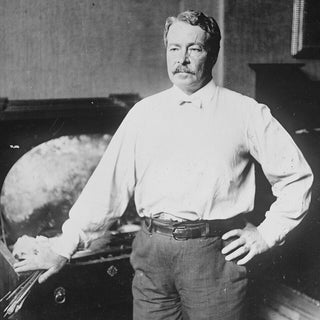
Joseph Decker was born in 1853 in the Kingdom of Württemberg, in southern Germany, the son of a carpenter. In 1867, when he was fourteen, his family emigrated to the United States and settled in Brooklyn. He was apprenticed to a house painter, then worked as a sign painter.
By the mid-1870s he wanted to become a serious artist. He began taking drawing classes at the National Academy of Design in New York, and soon exhibited portraits and landscapes at the Brooklyn Art Association. In 1879 he saved enough money to spend a year in Munich, studying with the history painter Wilhelm Lindenschmit.
When he returned he exhibited at the National Academy, the Brooklyn Art Association, the Society of American Artists and the Art Institute of Chicago, and set up a studio in Manhattan in the mid-1880s. This was when he painted the works that made him memorable: still lifes of fruit, mostly growing on the branch rather than arranged on a table.
These pictures are unlike anything else of the period. Decker painted plums, pears, peaches and grapes close up, in hard, sharp focus, often against dark backgrounds, with every bloom, blemish and leaf vein in place. The fruit is pushed right up to the picture surface and fills the frame. Green Plums (around 1885), Ripening Pears (around 1884–85), Grapes (around 1890–95) and Twelve Plums (1896) in our collection all show this striking, almost modern intensity. Critics at the time found the style too harsh, and the paintings did not sell well. The art historian William H. Gerdts later noticed similarities between some of Decker's paintings and the fruit illustrations on seed packets printed in Rochester, New York, in the same years.
After 1889 Decker stopped exhibiting. His later style became softer and more blended, and he painted landscapes, possibly influenced by George Inness. He also made genre scenes, portraits and novelty paintings in the shape of an artist's palette. His main patron was the collector Thomas B. Clarke, for whom he also worked restoring porcelain.
His last years are poorly documented, and he died in a charity ward of a Brooklyn hospital in 1924. His work was almost entirely forgotten until 1949, when the art historian Alfred Frankenstein called attention to it while researching American trompe-l'oeil painters.
Today Decker is recognised as one of the most original American still-life painters of the late nineteenth century, and his work is in the Metropolitan Museum of Art and the National Gallery of Art.
 Vincent van Gogh
 Claude Monet
 Gustav Klimt
 Winslow Homer
 John Singer Sargent
 Mary Cassatt
 Alphonse Mucha
 William Merritt Chase
 Childe Hassam
 Frederic Remington

 Snow & Moving Water · from $59
 Homer’s Atlantic · from $109
 Van Gogh in Colour · from $119
 Monet’s Changing Light · from $79
 Coastal Calm · from $109
 Harbour Days · from $59
 The Kitchen Table · from $79
 City Walks · from $119
 The Portrait Salon · from $109
 Early Modern Colour · from $79
 Blue Hour · from $119
 Golden Fields · from $109
 Field & Farm · from $59All gallery walls ›