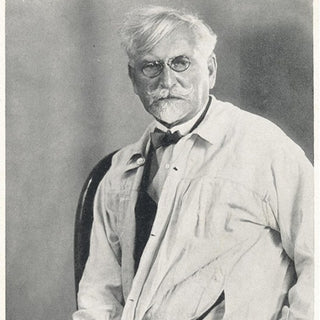
Alfons Maria Mucha was born in 1860 in Ivančice, in Moravia, now part of the Czech Republic. He sang in church choirs as a boy and drew constantly. After being turned down by the Prague Academy, he worked painting theatre scenery in Vienna, then decorated a castle in Moravia for Count Karl Khuen-Belasi. The count was so impressed that he paid for Mucha to study at the Academy of Fine Arts in Munich and then in Paris, where Mucha arrived in 1887.
When the count's support ended, Mucha scraped a living in Paris drawing illustrations for magazines and books. His break came at the end of 1894. The great actress Sarah Bernhardt needed a poster for her play Gismonda at short notice over the Christmas holiday, and Mucha, working at a printing firm, got the job. The poster, a tall, narrow, life-size figure in rich mosaic-like colour, appeared on the streets of Paris in January 1895 and caused a sensation. Bernhardt signed him to a six-year contract to design her posters, sets and costumes.
Mucha quickly became one of the most famous artists in Paris. Through the printer Champenois he designed advertising posters, calendars and decorative panels. His style, with graceful young women, long swirling hair, flowers, circular haloes and soft pastel colour, became so closely identified with Art Nouveau that people in Paris called it "le style Mucha."
The five works in our collection come from this golden decade of advertising. They include his posters for Lefèvre-Utile biscuits (1896), the travel poster Monaco Monte-Carlo for the PLM railway (1897), and his adverts for Chocolat Idéal and Bières de la Meuse (1899). Each sells a product, but what you remember is the woman, the flowers and the decorative curves around them.
Mucha also designed jewellery, interiors and the Bosnian pavilion at the Paris Exposition of 1900, and his handbook Documents décoratifs (1902) spread his style across Europe. He spent several years in the United States teaching and painting portraits.
His true ambition was nationalist and historical. From 1910 he worked for nearly twenty years on The Slav Epic, twenty enormous canvases telling the history of the Slavic peoples, which he gave to the city of Prague. After Czechoslovakia became independent in 1918, he designed its first postage stamps and banknotes.
When the German army occupied Czechoslovakia in 1939, Mucha was among the first people arrested and interrogated by the Gestapo. He died in Prague in July 1939, shortly after his release. The Mucha Museum in Prague is devoted to his work.
 Vincent van Gogh
 Claude Monet
 Gustav Klimt
 Winslow Homer
 John Singer Sargent
 Mary Cassatt
 Alphonse Mucha
 William Merritt Chase
 Childe Hassam
 Frederic Remington

 Snow & Moving Water · from $59
 Homer’s Atlantic · from $109
 Van Gogh in Colour · from $119
 Monet’s Changing Light · from $79
 Coastal Calm · from $109
 Harbour Days · from $59
 The Kitchen Table · from $79
 City Walks · from $119
 The Portrait Salon · from $109
 Early Modern Colour · from $79
 Blue Hour · from $119
 Golden Fields · from $109
 Field & Farm · from $59All gallery walls ›