
 Snow & Moving Water · from $59
 Homer’s Atlantic · from $109
 Van Gogh in Colour · from $119
 Monet’s Changing Light · from $79
 Coastal Calm · from $109
 Harbour Days · from $59
 The Kitchen Table · from $79
 City Walks · from $119
 The Portrait Salon · from $109
 Early Modern Colour · from $79
 Blue Hour · from $119
 Golden Fields · from $109
 Field & Farm · from $59
 Vincent van Gogh
 Claude Monet
 Gustav Klimt
 Winslow Homer
 John Singer Sargent
 Mary Cassatt
 Alphonse Mucha
 William Merritt Chase
 Childe Hassam
 Frederic Remington
Snow Is Never White: How Painters Learned to See Winter
October 23, 2026

Ask a child to paint snow and they'll reach for white. Ask an Impressionist, and they'll reach for blue, violet, pink and gold. In the second half of the nineteenth century, painters across Europe and America made a discovery that changed landscape painting: snow is hardly ever white.
Shadows full of colour
The Impressionists painted outdoors, in front of their subjects, and tried to record what the eye actually sees rather than what the mind knows. On a sunny winter day, they noticed, snow in sunlight is warm and yellowish, while snow in shadow reflects the blue sky above it. At dusk it turns pink and lilac. Claude Monet's The Magpie (1868–69), now at the Musée d'Orsay, with its blue shadows across a sunlit field of snow, is one of the first great examples. When it was submitted to the Paris Salon of 1869, it was rejected.
Monet kept painting winter for the rest of his career. Ice Breaking Up on the Seine near Bennecourt (1893) shows the moment of thaw, with floes of ice drifting on grey-blue water under a pale sky. In 1895 he travelled to Norway in midwinter to paint the snow there.
The Norwegian master
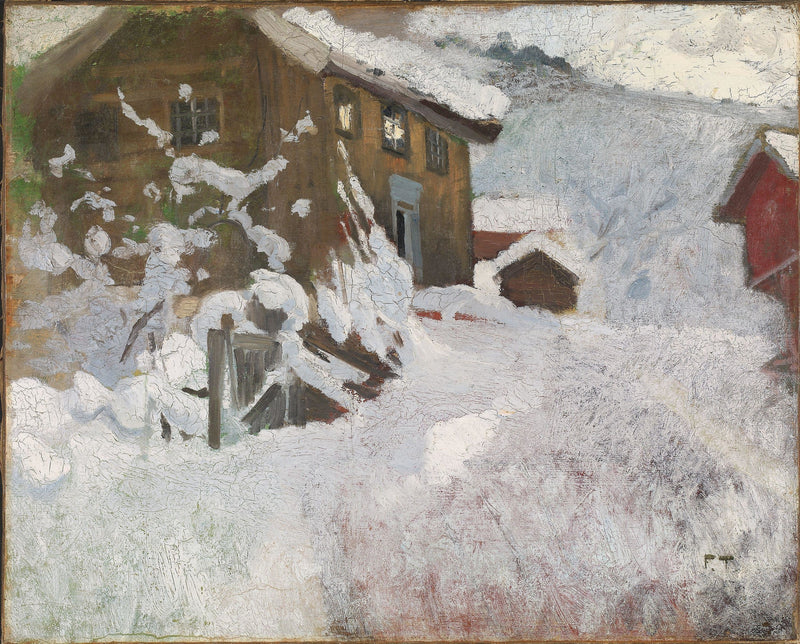
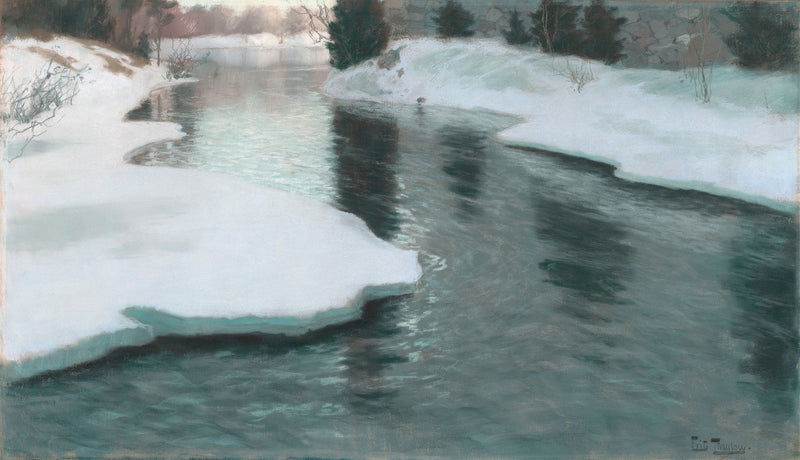
No painter was more closely associated with snow than the Norwegian Frits Thaulow. He painted it in every condition: freshly fallen, wet, melting, crusted with ice, in sunshine and twilight. His snow is rarely white. It holds the colours of the sky and the warm light of the low winter sun.
Norwegian Winter (1896) shows his characteristic winter landscape, with the snow modelled in cool blues and warm creams. Melting Snow (1887) captures the slushy days of the thaw, when snow and water meet. Thaulow made winter scenes popular in Paris, and collectors across Europe and America sought them out.
American winters
American painters took up the subject with enthusiasm. John Henry Twachtman, who lived on a farm in Greenwich, Connecticut, painted snow-covered fields and frozen brooks in nearly abstract fields of white, lavender and grey. Willard Metcalf, a friend of Twachtman and a fellow member of the Ten American Painters, painted the New England winter in clearer, crisper light. His Icebound Brook (1922) is a late example: a frozen stream between snowy banks, with the colour of the water just showing through.
Why snow paintings work so well at home
Winter landscapes are quiet pictures. Their palette of whites, blues and soft warm tones fits calmly into most rooms, and they bring a sense of stillness to a wall. They are lovely in a bedroom or living room in the winter months, and they pair beautifully with a white or light wood frame, which picks up the paper-white of the snow.
Explore more cold-weather art in our Landscapes collection, or see all of our Frits Thaulow prints.
Shop this story


 About the artistClaude Monet1840–1926 · FrenchThe founding figure of Impressionism, who spent sixty years trying to paint light itself.Read biography →
 Story Behind the Painting
 Artist Profile
 Story Behind the Painting